
Aerobic granular sludge cultures treat textile wastewater containing a recalcitrant dye and silver nanoparticles
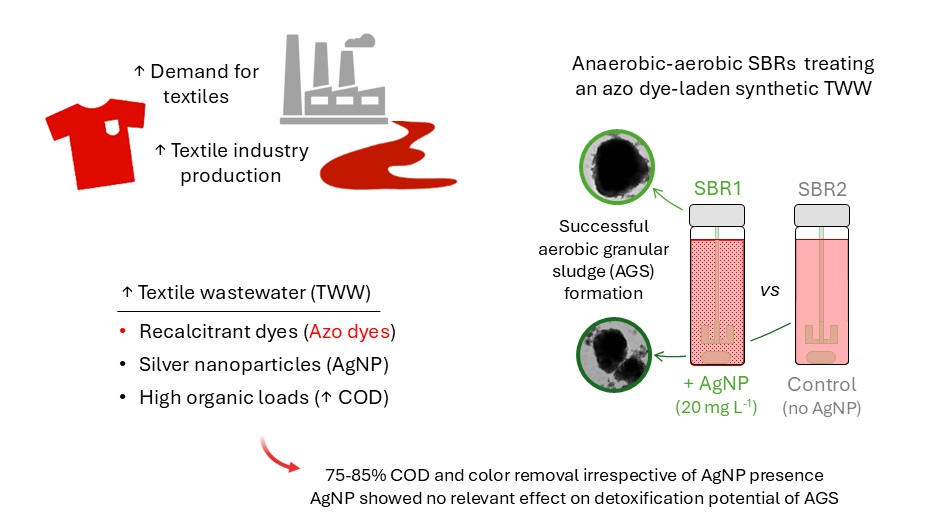
Textile industry wastewater (TWW) has long been characterized by high organic loads and recalcitrant dyes, but the increasing use of silver nanoparticles (AgNP) in textiles has added a new environmental challenge. In a study recently published in Ecotoxicology and Environmental Safety, synthetic TWW containing an azo dye was treated with aerobic granular sludge (AGS) in sequencing batch reactors (SBRs) and the impact of AgNP was evaluated under long-term operation. The study included the processes of initial granule formation and of granule reactivation after a period of 18 days during which the reactors were kept idle at 4 ºC. Two SBRs were operated for 246 days, one of which was fed with synthetic TWW containing 20 mg L⁻¹ AgNP and the other was operated as an AgNP-free control. Granulation was achieved after 40–50 days in both reactors, and AgNP was found to enhance AGS settling and biomass accumulation in the reactor, even through the reactivation period. AgNP accumulated in AGS but treatment performance was not affected, 80 % of azo dye reduction and organic load removal being reached after 1 and 2 weeks of operation, respectively, and maintained along the entire experiment in both SBRs. However, only the AgNP-fed granules were able to convert a recalcitrant aromatic amine, a metabolite from azo dye reduction, for prolonged periods of time. No significant differences in detoxification trends were observed between the reactors, and no correlation was found between the potential cytotoxicity/genotoxicity of mixed liquor samples and the presence of the azo dye or its metabolite. This study brings novel insights on the impact of AgNP on AGS granulation, stability and reactivation and includes toxicity assessment aspects, thus supporting the application of AGS in TWW treatment, even under intermittent discharge regimens and carrying emerging pollutants such as AgNP. This work was carried out by teams led by Nídia Lourenço of the Biochemical Engineering (BIOENG) group of the Research Unit on Applied Molecular Biosciences (UCIBIO) of NOVA University of Lisbon, and by Cristina Viegas at iBB-BSRG, with contributions from iBB-2BRG member Helena Pinheiro. Both teams are integrated in the Associate Laboratory Institute for Health and Bioeconomy (i4HB) and funding was provided by FCT under projects Biotextile (PTDC/EBB-EBI/120624/2010) and NanoMicroImpact (PTDC/AAG-TEC/4501/2014). See more.